Northern Virginia Beyond the Monuments: A Day Trip from Washington DC
What is there to do in Northern Virginia beyond Arlington and Alexandria?
Beyond the postcard sites, Northern Virginia is a wide arc of suburbs built around shopping (Tysons Corner), wineries around Leesburg, escape rooms, candle workshops and ghost tours in towns like Fairfax and Manassas. A car makes this loop realistic; it spreads across 30-45 minutes of driving from downtown DC, further than the compact Arlington-Alexandria core.
A Different Kind of Northern Virginia Day
If you’ve already stood at the Tomb of the Unknown Soldier at Arlington or wandered the waterfront in Old Town Alexandria, this page is not going to send you back there. Those two places anchor most people’s idea of a Northern Virginia day trip, and they earn that reputation. But the region around them — a broad arc of suburbs stretching from Tysons Corner out past Fairfax and Manassas to the wine country around Leesburg — is a genuinely different kind of destination, and one that rarely makes it into the standard itinerary.
This is a guide for the visitor who has done the monuments-and-history version already, or who has deliberately decided to skip it this trip, and wants to know what else exists within reach of Washington. The short answer: shopping that rivals anything downtown, a fast-growing suburban food and drink scene, a real wine region less than an hour out, and a handful of offbeat experiences — escape rooms, candle workshops, ghost walks — that have nothing to do with federal history at all.
None of this is a substitute for things to do in Northern Virginia at the historic sites if you haven’t seen them yet. It’s what comes after, or instead.
Why This Isn’t the Arlington-Alexandria Trip
It’s worth being explicit about the distinction, because the names overlap enough to cause confusion. Arlington and Alexandria are both technically part of Northern Virginia, and both sit close enough to the National Mall that a car is optional — Metro’s Blue and Yellow lines reach Arlington directly, and Alexandria’s Old Town is a short ride further on the same lines.
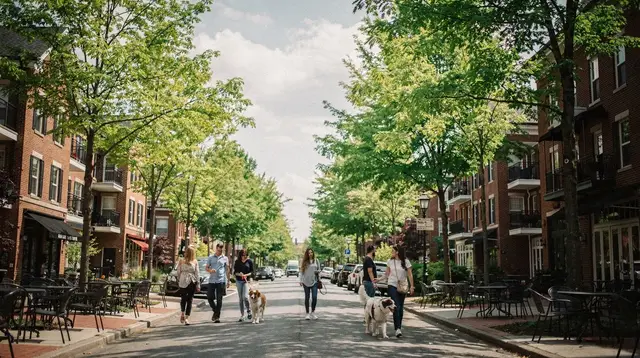
The territory this page covers starts where that convenience ends. Tysons Corner, Leesburg, Fairfax, Chantilly and Manassas form a much wider, lower-density suburban belt with its own logic: big-box retail centers, business parks, wineries on rolling farmland, and small-town main streets that grew up around railroads and courthouses rather than around a Metro stop. It’s the Northern Virginia that residents actually live in day to day, as distinct from the Northern Virginia that appears on a tourist map of DC’s must-sees.
If your itinerary already includes a stop at Mount Vernon or a walk through Arlington’s memorials, treat this as a separate day, not an add-on to the same loop — the driving patterns don’t overlap cleanly, and trying to cram both into one day usually means shortchanging one of them.
Getting There and Getting Around
This is the part where the advice genuinely inverts. Inside the capital core, a car is close to a liability: traffic is heavy, parking is scarce and expensive, and the Metro plus walking covers the National Mall, Capitol Hill and Georgetown more efficiently than driving ever could. The moment you’re aiming at Tysons, Leesburg or Manassas, that calculus flips entirely.
Tysons Corner is the one exception worth knowing about — it sits directly on the Silver Line, so it’s reachable by Metro without a car, roughly 25-30 minutes from downtown DC depending on your starting station. Everything past Tysons, though, has no rail service at all. Leesburg’s wineries, the Chantilly workshop spaces, and the historic downtowns of Fairfax and Manassas are reached by road, full stop.
As a rough planning guide:
| From downtown DC to… | Typical drive time (light traffic) | Metro option |
|---|---|---|
| Tysons Corner | 25-30 minutes | Yes — Silver Line |
| Fairfax | 30-40 minutes | No |
| Chantilly | 35-45 minutes | No |
| Manassas | 40-50 minutes | No |
| Leesburg / wine country | 40-50 minutes | No |
Those numbers roughly double during weekday rush hour on the Dulles Toll Road, I-66 and Route 7 — this is genuine commuter-belt traffic, not tourist congestion, and it follows a predictable 7-9am and 4-7pm pattern on weekdays. A Saturday or Sunday trip avoids most of it. For general orientation on driving and parking in Washington DC before you head out of the core, that guide covers the downtown side of the equation; once you’re on the Beltway or the Dulles Toll Road heading west, you’re effectively driving suburban Virginia, not the city.
Tysons Corner: Shopping and Suburban Dining
Tysons is, by retail square footage, one of the largest shopping destinations on the East Coast — split across two major malls (Tysons Corner Center and Tysons Galleria) that between them cover a genuinely enormous range, from mainstream mall anchors to a concentrated cluster of luxury boutiques that rivals anything in the district. It’s also grown a serious restaurant scene around and inside both centers, largely aimed at the office workers and residents of the high-rises that have gone up here over the past decade rather than at tourists — which is exactly why it feels different from anything near the Mall.
Beyond retail, Tysons has become a reliable spot for indoor activities that don’t depend on weather or daylight. An escape room is the obvious example: a couple of hours of puzzle-solving that works as well on a rainy afternoon as it does after a day of shopping. If you want to book one rather than hunt for options once you arrive, an escape room experience at Tysons Corner is a straightforward way to fill an evening slot.
Tysons is walkable in a limited, mall-centric sense — you can move between the two shopping centers and the nearby office-and-residential blocks on foot — but it is not a walkable town in the way Old Town Alexandria is. Plan to drive or Metro in, then park once or walk from the station, rather than expecting a stroll between multiple separate attractions.
Leesburg and the Virginia Wine Country
The area around Leesburg, in Loudoun County, has become one of the most productive wine regions on the East Coast, and it sits close enough to DC that a full-day visit is realistic without an overnight stay. This is the single most distinctive thing Northern Virginia offers that the Arlington-Alexandria core simply doesn’t have room for: rolling countryside, working vineyards, and tasting rooms that range from small family operations to larger estates with view terraces.
Because the wineries are spread across a genuinely rural area — not clustered in a single walkable district — the practical way to see several in one day without worrying about driving between tastings is a guided tour that handles the routing and the driving for you. A full-day tour to three wineries near Leesburg departing from the DC area covers exactly this ground, with transportation included — useful given how spread out the tasting rooms are and how little sense it makes to drive yourself between wineries once you’re sampling.
Leesburg’s small historic downtown itself is worth twenty minutes of walking beyond the vineyards — a genuine county-seat main street with independent shops and restaurants, a useful contrast to both the mall culture of Tysons and the colonial-tourism feel of Old Town Alexandria.
Fairfax, Chantilly and Manassas: The Overlooked Middle
Between Tysons and Leesburg sits a stretch of Northern Virginia that almost never appears in a DC guidebook at all: Fairfax city, Chantilly and Manassas. Each has its own small-scale draw, and together they round out a day trip with things that have nothing to do with federal history.
Fairfax’s compact old town has taken to hosting ghost walks that lean on the area’s genuine 18th- and 19th-century building stock rather than reenacting anything related to the battlefields further out; a guided ghost walk through historic Fairfax works well as an early-evening activity, roughly an hour long, before or after dinner in the same town.
Chantilly has developed a niche as a spot for hands-on craft workshops — a low-key, indoor, weather-proof activity category that barely exists anywhere near the National Mall. A mosaic candle holder workshop in Chantilly is a good example: a couple of hours making something to take home, pitched at casual visitors rather than dedicated hobbyists.
Manassas, better known regionally for its Civil War battlefield, also has a smaller, purely recreational side worth knowing about if battlefields aren’t the point of your day. A candle-pouring experience at a Manassas candle bar is the kind of low-stakes, hour-or-two activity that fits neatly into an afternoon without requiring any advance historical context.
None of these three towns are destinations in their own right for a first-time DC visitor with only a few days — they’re better understood as stops that make sense once you’re already driving through the area for Tysons or Leesburg, filling in the middle of a loop rather than anchoring it.
Building the Day: Three Honest Options
Given the driving distances involved, trying to see Tysons, Leesburg and the smaller towns all in one day is a stretch. Three more realistic shapes for the day:
Shopping-and-dining day: Metro or drive to Tysons Corner in the morning, spend the bulk of the day across the two shopping centers, add an escape room or an early dinner reservation, and head back into DC by early evening. This is the only version of the day that doesn’t strictly require a car.
Wine country day: Drive out to Leesburg by mid-morning, either self-driving between two or three wineries or booking the guided full-day tour to avoid doing your own driving between tastings, then walk Leesburg’s small downtown before heading back. Budget the full day — this is not a stop you can combine easily with much else given the distance.
Small-towns loop: For a lower-key day built around a couple of short activities rather than one big anchor, combine a workshop in Chantilly with a ghost walk in Fairfax or a candle-pouring stop in Manassas, timed around a relaxed lunch in one of the historic downtowns. This version works well as a rainy-day alternative to anything outdoor-focused.
Whichever shape you pick, build in real slack for traffic if any part of the loop touches rush hour — the Dulles Toll Road and I-66 corridor is one of the more congested commuter routes in the country, and DC’s own travel mistakes to avoid guide is worth a skim if you’re new to driving in the region generally, even though most of its advice is about the downtown core rather than the suburbs.
What This Day Trip Deliberately Skips
To be clear about scope: this page does not cover Arlington National Cemetery, the changing of the guard, or Arlington House — that’s the subject of the dedicated Arlington day trip guide and the Arlington National Cemetery visitor guide. It also doesn’t cover Old Town Alexandria’s waterfront, historic district or ghost tours, which have their own page in the Alexandria day trip guide, and it skips Mount Vernon entirely, covered separately in the Mount Vernon day trip guide.
If you haven’t done any of those three yet, they’re the more traditional starting point for a Northern Virginia day away from downtown, and arguably better first-timer choices than shopping malls or wineries. This guide exists for the visitor who has already checked those off, is planning a longer stay in the region, or simply wants a day that has nothing to do with monuments, cemeteries or Founding Fathers.
Practical Notes Before You Go
A few things worth confirming before setting out. Tolls apply on the Dulles Toll Road and the Dulles Greenway further out toward Leesburg — have a way to pay electronically (E-ZPass or a rental car’s built-in toll system) rather than expecting cash booths. Winery tasting fees are typically charged per person and are separate from any bottle purchases; most Loudoun County wineries accept walk-ins on weekdays but recommend reservations on weekends, when tasting rooms fill up quickly. Tysons Corner’s two malls are connected by a short walk or a quick Silver Line ride between their respective stations — don’t assume they’re a single building.
As with any purchase in Virginia, sales tax (roughly 5.3-6% depending on the specific county) is added at checkout rather than included in the sticker price, and restaurant tabs carry the same tipping norms as the rest of the DC region — roughly 18-20% for table service. None of this is unique to Northern Virginia, but it’s easy to forget once you’re outside the more tourist-oriented pricing of downtown DC.
If you’re building this into a longer, car-based swing through the wider region rather than a single day, it pairs naturally with the sites further out covered in things to do in Northern Virginia and with the broader wineries and breweries near Washington DC guide, which covers Maryland’s drinking-and-touring scene alongside Virginia’s for anyone weighing the two.
Frequently Asked Questions About a Northern Virginia Suburbs Day Trip
Is this the same trip as visiting Arlington or Alexandria?
No. This guide assumes you have already covered Arlington National Cemetery and Old Town Alexandria, or plan to on a separate day, and focuses on what the wider Northern Virginia suburbs offer beyond those two well-covered stops.
Do I need a car for Tysons and Leesburg?
Yes, effectively. Tysons Corner has a Metro stop, but Leesburg’s wineries, Manassas and Chantilly have no rail service at all. A car is what turns this into a single coherent day rather than three disconnected errands.
How far is Leesburg from Washington, D.C.?
Leesburg is roughly 40-50 minutes from downtown DC by car outside rush hour, and can stretch well past an hour during weekday commute traffic on the Dulles Toll Road and Route 7.
Can I combine Tysons Corner with a winery visit in one day?
It is possible but tight. Tysons and the Leesburg wine country sit about 30 minutes apart, so a realistic day picks one as the anchor (shopping and dining, or wine tasting) and treats the other as a shorter stop on the way in or out.
Is Northern Virginia walkable like downtown DC?
No. Unlike the National Mall core, where a car is a handicap, Northern Virginia is low-density suburban sprawl connected by arterial roads and highways, so walking between stops is rarely practical.
What’s a good non-touristy activity for an evening in this area?
An escape room in Tysons Corner or a guided ghost walk in Fairfax both work well as an evening add-on after a day of shopping or wine tasting, and neither requires advance planning beyond booking a slot.
Day Trips from Washington
Verified deep-linked GetYourGuide tours. Book through these links and we earn a small commission at no cost to you.
GetYourGuide does not provide a product photo for this activity — the image shows the meeting point, photographed by us.