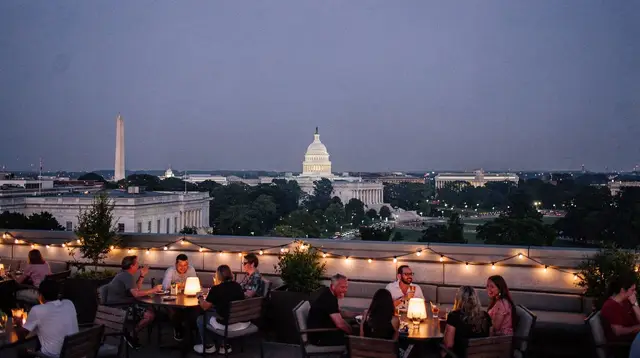
Washington, D.C. Bars and Nightlife: The Codes to Know Before You Go Out
How much do you tip at bars in Washington, D.C.?
Expect to tip roughly 18-20% on a cocktail or mixed drink, or $1-2 per drink for beer or wine at the bar. This is the expected social norm in the US, not an optional extra, and it comes on top of Washington's 10.25% alcohol tax added at the till.
Washington’s after-dark scene runs from rooftop bars overlooking the Potomac to dive bars near Capitol Hill to cocktail lounges tucked into Georgetown row houses, and the city has plenty of it. But the single biggest surprise for international visitors isn’t which neighborhood to pick — it’s the bill. Two habits that barely exist in most of Europe are baked into every round you order here: tipping the bartender and paying a special tax on alcohol that never shows up on the menu. Get those two things straight before your first night out, and the rest of DC’s nightlife is easy to enjoy.
The tipping trap: why your bar tab is never the menu price
If you’re used to European bars, where the price on the chalkboard is the price you pay and a tip is a small, optional gesture for exceptional service, Washington will feel disorienting at first. In the United States, tipping at a bar is not a bonus — it is the expected, baseline way that bartenders and bar staff are paid. Skipping it isn’t a subtle faux pas; it’s the kind of thing bar staff will actually notice and remember if you come back.
The standard breakdown:
| What you order | Expected tip |
|---|---|
| Cocktails, mixed drinks | 18-20% of the drink price |
| Beer or wine by the glass | $1-2 per drink |
| A round for a group | $1-2 per drink, or 18-20% on the total if it’s cocktail-heavy |
This is a completely different calculation from tipping at a restaurant table, where servers are tipped roughly 18-20% of the pre-tax bill for a full meal with table service — that’s covered in DC’s dining and restaurant guides, not here, because bar tipping and restaurant tipping run on separate norms even though the percentages look similar.
A practical way to think about it: if you’re running a card at the bar and settling your tab at the end of the night, most point-of-sale systems will prompt you with suggested tip percentages (often 18%, 20%, 22%) right on the screen. Choosing the lowest option is fine; choosing “no tip” for full table or bar service is the move that gets noticed. If you’re paying cash and ordering drink by drink, leaving $1-2 on the bar as you go is the norm bartenders expect and rely on.
The other surprise: alcohol has its own tax rate in DC
Even before tipping enters the picture, the price on the menu isn’t what you’ll actually pay. Washington, D.C. charges a special alcohol tax of 10.25% — noticeably higher than the district’s general sales tax — and it is added at checkout, never included in the menu price you see when you order. This is standard practice across the United States: unlike VAT in much of Europe, sales tax in the US is calculated and added at the register or the final tab, not folded into the displayed price.
So a $14 cocktail on the menu becomes:
| Line item | Amount |
|---|---|
| Menu price | $14.00 |
| Alcohol tax (10.25%) | ~$1.44 |
| Subtotal | ~$15.44 |
| Tip (18-20% of drink price) | ~$2.50-2.80 |
| Actual cost | ~$18-18.25 |
That’s roughly 30% above the number printed on the menu, purely from tax and tip — and it’s the same math on every round, every night. There’s no way around it and, unlike a European VAT receipt, no refund mechanism waiting for you at the airport. Visitors sometimes budget a night out based on menu prices alone and are caught off guard when the actual bar tab lands; building in that 25-30% cushion from the start avoids the surprise.
Where to expect this in Washington’s nightlife scene
DC’s nightlife spans several distinct pockets, and the tipping and tax rules apply identically everywhere in the district — what changes is the vibe and the crowd:
- Georgetown: cocktail bars and lounges along the waterfront and up M Street, generally a dressier, pricier scene.
- Capitol Hill / Barracks Row: a mix of neighborhood pubs and late-night spots popular with staffers and locals.
- U Street / Shaw: DC’s historic jazz and live-music corridor, with bars that lean into the neighborhood’s African American cultural heritage.
- The Wharf / Potomac waterfront: newer rooftop and waterside bars with river views, popular for sunset drinks.
- Adams Morgan: a dense strip of bars and later-night spots with a younger, louder crowd on weekends.
Whichever pocket you’re in, the same two rules apply: budget for the tip on every round, and expect the final tab to run above the printed menu price once the 10.25% alcohol tax lands.
Each pocket also rewards a slightly different approach to the night. Georgetown’s cocktail lounges are the ones most likely to enforce a dress code or a reservation for a table, so it’s worth calling ahead if you’re set on a specific rooftop or waterfront spot on a Friday or Saturday. Capitol Hill and Barracks Row lean toward standing at the bar or grabbing a high-top with a group, which is exactly the setting where running an open tab makes the most sense.
U Street and Shaw venues often have a cover charge on nights with live music, on top of the usual drink prices, tax, and tip — worth budgeting for separately if a show is part of the plan. The Wharf’s rooftop bars fill up fastest around sunset, so arriving before the crowd is the easiest way to get a river-facing seat without a wait. Adams Morgan, being the loudest and latest of the group, is also the neighborhood where splitting a tab evenly with a larger group comes up most often, so it’s worth settling that question with your group before the first round rather than at 1am.
Practical etiquette beyond tipping and tax
A few other habits are worth knowing before your first night out in Washington:
- ID checks are strict and universal. The legal drinking age is 21, and bars routinely card everyone who looks under 30 or 40, regardless of nationality. A passport works as ID for international visitors; carry it rather than assuming a driver’s license from home will be accepted without question.
- Last call varies by night and venue. Many DC bars run until around 2am on weeknights and closer to 3am on Friday and Saturday, but individual venues set their own hours, and some close earlier — check before you plan a late finish.
- Running a tab is normal. Handing over a card at the start of the night and running an open tab, settled (with tip) when you leave, is standard practice and generally faster than paying drink by drink in cash.
- Splitting a bar tab evenly among a group is common, even if people ordered different drinks — it’s worth agreeing on this with your group before the round starts rather than after the bill arrives.
- Dress codes exist at some cocktail lounges, particularly in Georgetown and at rooftop bars, though DC nightlife is generally more casual than New York’s.
Pairing drinks with food instead of a straight bar crawl
Not every night out in DC needs to center on a string of bars. A number of visitors prefer to fold the drinking into an evening built around food instead, moving between a few small plates and a round of drinks at each stop rather than treating the bar as the whole point of the night. An evening neighborhood food tour that pairs bites with drinks at each stop works well for this — the same tipping and 10.25% alcohol tax rules still apply at every bar along the way, but the pacing is gentler than a dedicated pub crawl, and it suits travelers who want to sample a neighborhood’s character without committing to a late finish.
Putting it together for one night out
For a realistic sense of scale: a couple ordering four cocktails between them at a Georgetown lounge, at roughly $15 each on the menu, is looking at about $60 in drinks, plus roughly $6.15 in alcohol tax, plus an $11-12 tip — landing closer to $77-78 total for four drinks. That’s the number to plan around, not the $60 the menu implied. Multiply that pattern across two or three bars in one night, and the difference between “menu price” and “actual cost” becomes real money, which is exactly why this guide leads with tipping and tax rather than burying them as a footnote.
If you’d rather have the history and stories built into your night out instead of navigating the bar-hopping decisions solo, a guided pub crawl through Washington’s history pairs the drinking with context on the city’s Prohibition-era spots and political lore, and takes the guesswork out of where to go — though the same tipping and tax rules still apply at every stop. Just across the river, an Old Town Alexandria haunted pub crawl makes a fitting nightlife detour for the same reason: a guide handles the route and the stories while you focus on the round in hand rather than the tab.
Nightlife pairs naturally with the rest of a DC trip: many visitors combine an evening out with daytime visits to the National Mall monuments or a walk through the Smithsonian museums, before heading out in Georgetown or along The Wharf once evening falls. If you’re staying near Capitol Hill or downtown, most of the city’s bar districts are a short Metro ride away, which matters given how driving and parking in DC can complicate a night that involves drinking.
For visitors building a broader budget, it’s worth reading DC’s dedicated guide on tipping and sales tax alongside this one, since the two taxes and tipping norms (restaurant vs. bar) are easy to conflate but calculated differently. And if this is your first trip to the US generally, the common travel mistakes to avoid guide covers several more habits, from tipping to tax, that catch first-time visitors off guard beyond just nightlife.
Those exploring beyond the bars themselves might also enjoy DC’s food and markets scene or a look at the city’s wine and breweries for a lower-key evening than a full bar crawl. And if you’re trying to fit nightlife into a tight schedule alongside museums and monuments, the tight-schedule guide has practical sequencing advice for evenings after a full day of sightseeing.
Washington, D.C. bars and nightlife FAQ
How much should I tip a bartender in Washington, D.C.?
Around 18-20% of the drink price for cocktails and mixed drinks, or a flat $1-2 per round for beer and wine. Bartenders in the US rely on tips as a real part of their income, so this isn’t a bonus for great service — it’s the baseline expectation for any service at all.
Is tipping at a bar really mandatory in Washington, D.C.?
It isn’t legally mandatory, but socially it functions that way. Skipping it is noticed, and bar staff in DC are generally paid a lower base wage on the assumption that tips make up the difference, exactly as in the rest of the United States.
Why is my bar tab higher than the menu price suggested?
Washington, D.C. adds a special 10.25% tax on alcohol sales, applied at checkout and never folded into the price shown on the menu or the chalkboard. Add your tip on top of that, and a $14 cocktail can land closer to $18-19 all in.
Can I get a tax refund on drinks I bought in Washington, D.C.?
No. Unlike VAT in much of Europe, US sales and alcohol taxes are not refundable to visitors under any circumstance, whether you’re a tourist, a business traveler, or leaving the country the next day.
Do I need to tip if I just order one beer and leave?
Yes, even for a single drink. The norm is $1-2 per drink at a minimum, so a lone beer at the bar still gets a dollar or two left on the counter or added when you settle up on a card.
What’s the difference between tipping at a bar and tipping at a restaurant in DC?
Bar tipping is usually a flat $1-2 per drink or 18-20% on cocktails, calculated drink by drink or on the final bar tab. Restaurant tipping runs on the full pre-tax bill, also around 18-20%, and is covered separately in DC’s restaurant and dining guides, not here.
Is nightlife in Washington, D.C. expensive compared to Europe?
It runs comparable to or above many major European cities once tipping and the 10.25% alcohol tax are factored in on top of menu prices, which is exactly the trap: the sticker price never tells the whole story until the tab arrives.
What time do bars close in Washington, D.C.?
Last call in DC typically runs to around 2am on weeknights and 3am on Friday and Saturday nights, though exact hours vary by establishment and neighborhood, so it’s worth checking a specific venue’s posted hours before planning a late night out.
Bars and Nightlife
Verified deep-linked GetYourGuide tours. Book through these links and we earn a small commission at no cost to you.
GetYourGuide does not provide a product photo for this activity — the image shows the meeting point, photographed by us.