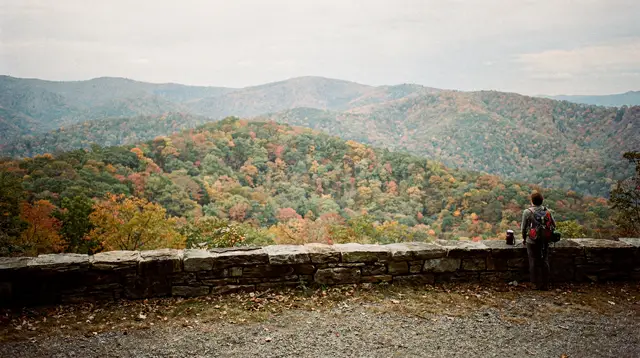
Shenandoah National Park and Skyline Drive Guide
What is Skyline Drive and how far is it from Washington, D.C.?
Skyline Drive is a 105-mile scenic road running the length of Shenandoah National Park's mountain ridge, with dozens of overlooks across the Blue Ridge. The park's nearest entrance is roughly 1.5 to 2.5 hours from Washington, D.C. by car, and a vehicle is required — there is no train or bus service into the park.
There’s a particular kind of day trip out of Washington that has nothing to do with monuments, muskets, or presidents’ bedrooms: you just drive up into the mountains, roll the windows down, and stop every few miles because the view got better again. That’s Skyline Drive. It runs the entire length of Shenandoah National Park along the crest of the Blue Ridge, and for a lot of visitors staying in DC, it’s the closest real mountain scenery they’ll see on the whole trip.
This guide treats the drive itself as the destination — not a single hike, not a historic house, not a battlefield. If you want George Washington’s boyhood friend’s plantation or Thomas Jefferson’s hilltop mansion, that’s Charlottesville and Monticello, a worthwhile add-on to this same region but a genuinely different day, with its own page.
And if you’re drawn to Harpers Ferry at the northern edge of this same mountain country, know that it belongs to a different story here too — that town is where a river gorge meets Civil War history, covered on our civil war battlefields guide, not this one. Here, the subject is ridge, road, and air.
Why people drive up here
Shenandoah National Park protects a long, narrow strip of the Blue Ridge Mountains — around 200,000 acres of forested ridgeline that was, remarkably, farmland and small mountain communities before the park was established in the 1930s. Skyline Drive was built along the spine of that ridge specifically to let people see the view without leaving their car, and that’s still exactly what it does. Depending on where you enter, you’re looking west into the Shenandoah Valley or east toward the piedmont and, on a clear day, all the way to the haze over the Washington area you just left.
The appeal is simple: no ticket, no timed pass, no guided narration required (though you can add one). You drive, you stop, you look, you drive on. It rewards a slow pace more than a rushed one — the difference between a good Skyline Drive day and a mediocre one is usually how many overlooks you actually stopped at, not how many miles you covered.
Getting there and the entrance fee
From Washington, the drive to the nearest Shenandoah entrance takes roughly 1.5 to 2.5 hours depending on which gate you’re aiming for and traffic through Northern Virginia. That range matters when you’re planning your day — the northern entrance near Front Royal is the closest option from DC, while entrances further south add real time.
A car is essentially mandatory. There’s no train, no bus, and no Metro connection anywhere near the park — this is one of the clearest cases in the whole capital region where you either rent a car, bring one, or join a tour that provides transportation.
If you’d rather not drive the mountain roads yourself, a private day tour from Washington to Shenandoah National Park keeps the pace and stops flexible without you behind the wheel — worth comparing against the small-group option above if you’re traveling with family or simply prefer your own vehicle and driver for the day.
At the gate, Shenandoah charges a per-vehicle entrance fee, valid for multiple consecutive days. Because park fees are periodically revised, this page won’t print a number that risks going stale — check the current rate on the park’s own site before you go, and know that an annual national parks pass, if you already hold one, typically covers it.
| Consideration | What to expect |
|---|---|
| Drive time from DC | Roughly 1.5–2.5 hours depending on entrance gate |
| Entrance fee | Charged per vehicle at the gate; multi-day validity |
| Public transit | None — a car or a tour with transportation is required |
| Best single-day approach | Enter one gate, drive a segment of the ridge, exit another |
| Cell signal | Patchy to nonexistent along much of the ridge |
Driving the ridge: what a day actually looks like
Skyline Drive runs 105 miles from Front Royal in the north to Rockfish Gap in the south, where it hands off to the Blue Ridge Parkway. Very few day-trippers from DC drive the whole thing — most enter near the northern end, drive a comfortable stretch, and turn around or exit through a different gate to loop back toward home.
The speed limit along the entire drive is a strict 35 mph, and that’s not really a hardship — it’s a two-lane mountain road with sharp curves, occasional deer standing in the roadway, and views that genuinely deserve the slower pace. Plan on the drive itself taking meaningfully longer than the mileage suggests.
A realistic one-day plan from DC looks something like this:
- Leave DC early — traffic through Northern Virginia builds quickly on weekend mornings.
- Enter through the northern section of the park, closest to Front Royal.
- Stop at several overlooks in the first hour, rather than racing to a single “best” one — the light and the view genuinely change through the day.
- Break for a short trail if you want to stretch your legs, but keep it brief; this is a driving day, not a hiking day.
- Exit and either loop back to DC or continue on to Luray Caverns (below) before heading home.
Traffic at the entrance stations can back up on autumn weekends, particularly during peak leaf season in mid-October, so a weekday visit or an early start smooths out the whole day considerably.
Luray Caverns: the paid stop on the way
Luray Caverns sits just outside the park, near the town of Luray, and it’s the single most popular add-on to a Skyline Drive day — a vast network of limestone caverns with towering formations, underground pools, and a genuinely unusual pipe organ built from the stalactites themselves. It’s a private, paid, ticketed attraction, entirely separate from the national park and its entrance fee.
Because it draws crowds, especially on weekends and in fall, booking a timed ticket ahead of arrival is the safer move rather than hoping for a same-day slot. If your day trip combines the drive and the caverns, that’s essentially a full day out — leave DC by mid-morning at the latest.
If Luray Caverns is the actual goal and Skyline Drive is secondary, skip the driving altogether: a private round-trip transfer from DC to Luray Caverns gets you there and back without renting a car or navigating the ridge roads yourself. A more comprehensive alternative pairs the cavern visit with other stops in one loop — a day trip combining Shenandoah, Luray Caverns, and a Middleburg vineyard stop — useful if you want the mountain scenery, the caverns, and a wine stop in a single, guided day rather than three separate trips.
For travelers who’d rather not deal with routing, timing, and driving the mountain roads themselves, a small-group day trip from DC that combines Shenandoah’s overlooks with a stop at Luray Caverns handles the whole loop, entrance logistics included. There’s also a more caverns-focused option — a guided day trip from Washington built specifically around the Luray Caverns visit, useful if the caverns are the priority and the mountain drive is the bonus rather than the other way around.
When to go
Every season on the ridge looks different, and none of them is objectively “wrong,” but they trade off differently for a day-trip visitor:
- Spring (April–May): Wildflowers, waterfalls running full from snowmelt, and noticeably fewer crowds than autumn. Weather can still be unpredictable at elevation.
- Summer (June–August): Long daylight hours, but afternoon haze and pop-up thunderstorms are common in this humid subtropical region, and views can dull by midday.
- Autumn (late September–October): Peak leaf season, typically cresting in mid-October, is the single most popular — and most crowded — window. Weekday visits or early starts matter more here than any other time of year.
- Winter (December–February): Quiet and often starkly beautiful, but sections of Skyline Drive close temporarily after snow or ice, and some services shut for the season. Check conditions before committing to a winter visit.
What this trip is not
Worth being direct about the boundaries of this page, since the region blurs together in a lot of trip-planning searches:
- Not a historic house tour. Monticello and Charlottesville sit close by geographically but belong to their own day — Jefferson’s mountaintop estate and a college town, not a drive along a ridge.
- Not a Civil War site. Harpers Ferry, at the park region’s northern edge, has its own real weight of war history — a Union arsenal, John Brown’s raid, a dramatic river confluence fought over repeatedly — and it’s covered from that angle on our Civil War pages, not here.
- Not a single-hike destination. This page treats the drive and its overlooks as the main event. If summit hikes and waterfall trails are what you’re after, that’s a more specific plan than a general Skyline Drive day, and worth researching separately once you know which section of the ridge you’ll be near.
- Not free. Between the park’s per-vehicle entrance fee and, if you add it, Luray Caverns’ ticket price, this is a paid day out — just not an expensive one by the standards of the region’s historic Virginia sites.
Practical notes before you go
Fill your gas tank before entering — there are limited fuel stops inside the park and none directly on Skyline Drive itself for long stretches. Cell signal is unreliable to nonexistent along much of the ridge, so download offline maps or a paper map as backup rather than relying on your phone’s live directions once you’re past the entrance station. Layer clothing even in warmer months; temperatures at elevation on the ridge run noticeably cooler than down in DC, sometimes by ten degrees or more.
For visitors combining this drive with other parts of the wider Shenandoah and Blue Ridge region, or comparing it against other Civil War-adjacent stops in civil war country, it’s worth reading the difference between the two territories before you build your itinerary — the mountains and the battlefields sit close on a map but tell entirely different stories.
Pairing this trip with the rest of your visit
Skyline Drive rarely sits alone on an itinerary — most visitors are also splitting time between downtown DC and one or two other day trips. If you want a structured version of this exact outing, our Shenandoah and Charlottesville two-day itinerary spreads the ridge drive and the college-town-and-Monticello day across two separate days rather than cramming both into one long push. For a broader look at the mountain-and-caverns day specifically, see our dedicated Shenandoah National Park day trip from Washington, D.C. guide, which covers the same territory with a tighter focus on logistics.
Travelers building out a longer trip sometimes stack this drive against other outdoor stops in the region — see our roundup of outdoor spaces and parks near Washington, D.C. for how Shenandoah compares to closer-in options that don’t require a half-day of driving each way. If the Civil War side of this same general area is more your interest than mountain scenery, our Gettysburg vs. Antietam comparison and the broader civil war battlefields guide cover Harpers Ferry, Antietam, and Gettysburg without any overlap with this page’s ridge-and-road focus.
For the drive itself, our driving and parking in Washington, D.C. guide is worth a skim before you leave — it covers getting a rental car out of the city cleanly, which is usually the fiddliest part of an early-morning start toward Front Royal. And if you’re weighing whether autumn is really the best time to go, our blog post on Skyline Drive in autumn goes deeper into the leaf-season trade-offs than the summary above.
Shenandoah and Skyline Drive: frequently asked questions
How much does it cost to enter Shenandoah National Park?
Shenandoah charges a per-vehicle entrance fee at the gate, valid for multiple days, on top of any pass you might already hold for other national parks. Check the current fee before you go, since park fees change from year to year and this page won’t guess a number that might already be wrong by the time you read it.
Is Skyline Drive worth it if you only have one day?
Yes, if you treat it as a driving-and-viewpoint day rather than a hiking expedition. A loop that enters one gate, drives a stretch of the ridge, stops at a handful of overlooks, and exits another gate fits comfortably into a day trip from DC, especially if you also add Luray Caverns.
Do I need to book Luray Caverns in advance?
Luray Caverns sells timed tickets, and it gets busy on weekends and in autumn, so booking ahead is safer than showing up and hoping for the next available slot. It’s a paid, separate business from the national park, not a park facility.
Can I visit Shenandoah without a car?
Not really. There is no public transit into the park or along Skyline Drive, so a rental car or a guided small-group tour that includes transportation is effectively the only way to see the ridge and its overlooks.
What’s the best time of year to drive Skyline Drive?
Mid-October is peak leaf season and also peak traffic — some weekend afternoons see the entrance stations queue up. Late spring and early autumn give clearer, less crowded overlooks; summer afternoons often bring haze and thunderstorms that dull the views.
Is Skyline Drive the same as the Blue Ridge Parkway?
No. Skyline Drive is the 105-mile road inside Shenandoah National Park. The Blue Ridge Parkway begins where Skyline Drive ends, at the park’s southern boundary, and continues for hundreds of miles further south through Virginia and North Carolina — a much longer drive well beyond a day trip from DC.
Are there towns or historic house tours along the way?
Charlottesville and Monticello sit near this same region but are a different kind of day out — a college town and a presidential estate, not a mountain drive. This guide sticks to the ridge, the overlooks, and the cavern stop; pair a Charlottesville visit with its own trip if history and architecture are what you’re after.
Monuments and Memorials Tours
Verified deep-linked GetYourGuide tours. Book through these links and we earn a small commission at no cost to you.
GetYourGuide does not provide a product photo for this activity — the image shows the meeting point, photographed by us.