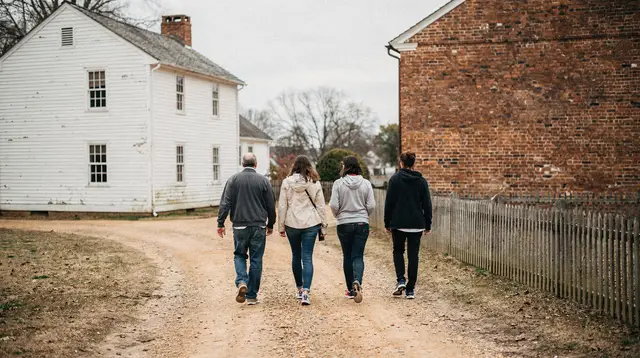
Why Colonial Williamsburg isn’t a quick stop
Colonial Williamsburg is often described as a “colonial town you can walk through,” and that description undersells it badly. This is a 301-acre living-history museum with hundreds of restored and reconstructed 18th-century buildings, dozens of working trade shops, and a full daily schedule of costumed interpretation, all of it run as a large ticketed institution rather than a free downtown. Treat it the way you’d treat a major museum complex with grounds the size of a small campus, not a stroll past historic storefronts.
That distinction matters for planning. The streets, the sidewalks, and views of building exteriors are open to the public at no charge, and you can absolutely walk Duke of Gloucester Street for free. But the moment you want to step inside the Capitol, the Governor’s Palace, the Peyton Randolph House, or watch a blacksmith, wigmaker, or printer at work in their shop, you need an admission ticket. That ticket is also what pays for the costumed interpreters, the historic trades program, and the daily reenactments that are the actual point of visiting. Skipping the ticket to “just look around” means missing almost everything that makes the site worth the drive.
Because the historic area is so large and so program-dense, Colonial Williamsburg sells single-day general admission but leans heavily toward multi-day passes, and for good reason: seeing the major buildings, catching a handful of trade demonstrations, and taking in an evening program (ghost walks, taverns, or seasonal events) genuinely takes more than one day for most visitors. If you’re coming primarily for this site, a two-day or longer ticket is usually the better value and the better experience than a rushed single day.
Getting here from Washington, D.C.
The drive from Washington to Williamsburg runs roughly 2.5 to 4 hours depending on traffic and route (via I-95 and I-64, or the more scenic but slower Route 17/US-17 through Fredericksburg). That’s long enough that a same-day round trip is a bad idea for anyone who actually wants to see the site rather than glimpse it. Given the site’s size, plan this as a trip with at least one overnight, not a day trip squeezed onto a Washington itinerary.
If you’re building a longer Virginia loop, Williamsburg pairs naturally with a stop in Richmond, Virginia’s current state capital, about an hour to the west, and with the Historic Virginia region’s other colonial sites. Amtrak also runs service to Williamsburg station from the DC area, useful if you’d rather not drive the whole way.
What’s actually inside a ticket
A Colonial Williamsburg admission ticket covers entry to the historic area’s ticketed buildings and grounds: the Capitol, the Governor’s Palace, the Courthouse, dozens of historic trade shops (blacksmith, cabinetmaker, silversmith, printer, and more), and the daily schedule of interpreter-led programs and demonstrations. Multi-day tickets are priced to reward a longer stay, since the daily program rotates and a single day rarely covers every trade shop or building.
| Ticket type | What it covers | Best for |
|---|---|---|
| Single-day general admission | All ticketed buildings and trade shops for one day | A tight schedule, or combining with a nearby overnight elsewhere |
| Multi-day pass (2-3 days) | Same access spread across consecutive days | Most first-time visitors; the standard recommendation |
| Annual pass | Unlimited entry for a year | Regional residents or repeat visitors |
| Evening/specialty programs | Ghost walks, tavern experiences, seasonal events | Add-ons, usually booked separately from general admission |
Hotel packages bundling lodging with multi-day admission are common in Williamsburg and often work out cheaper than buying tickets and rooms separately, especially outside peak summer weekends.
The trap: Jamestown and Yorktown are not included
This is the single most common budgeting mistake visitors make, so it’s worth stating plainly: a Colonial Williamsburg ticket does not include Jamestown or Yorktown. These are separate historic sites, run by separate organizations, with their own separate admission fees.
- Jamestown Settlement (living-history museum with replica ships and a recreated fort) and Historic Jamestowne (the actual original 1607 archaeological site) are their own ticketed attractions, roughly 15-20 minutes from Williamsburg.
- Yorktown, where the decisive battle of the Revolutionary War ended in 1781, has its own battlefield park and the American Revolution Museum at Yorktown, again separately ticketed.
Together, Williamsburg, Jamestown, and Yorktown form the “Historic Triangle,” and combination tickets covering more than one of the three do exist and are worth checking before you buy separately. But don’t assume your Williamsburg pass gets you through the gate at either neighbor — budget for each site individually unless you’ve confirmed a combo ticket covers it. If you’re weighing how to split your time between the three, a comparison of Williamsburg, Jamestown and Yorktown is worth reading before you book anything.
Not a museum piece: living history, in character
Colonial Williamsburg’s defining feature is that its interpreters stay in character and in trade, all day, rather than delivering scripted lectures. You’ll find a blacksmith actually forging tools, a printer actually running an 18th-century press, and costumed historical figures — sometimes portraying real people from the 1770s — walking the streets and engaging visitors in period conversation. It’s closer to a functioning small town frozen at a specific moment than a static museum exhibit, and that’s deliberate: the goal is immersion, not display cases.
For visitors who want a guided angle on this, several tours built specifically for Colonial Williamsburg dig into the parts of the story that a self-guided walk can miss. A tour focused on the lives of colonial-era women covers domestic life, trades, and social roles that the main visitor narrative sometimes skips.
For a broader overview with a live guide, a private walking tour through Williamsburg’s colonial history lets you set the pace and ask questions as you go, and a tour centered on the Revolutionary-era patriots who lived and worked here leans into the town’s role in the run-up to independence.
Evenings shift tone considerably. Williamsburg’s after-dark programs are a genuine draw in their own right: an evening walk built around the town’s ghost stories and a private culinary walking tour tasting foods along the historic streets both work well after the daytime trade shops close, and neither one substitutes for a general admission ticket during the day — they’re add-ons to, not replacements for, the site’s main ticketed experience.
Correcting a few common mix-ups
“Colonial Williamsburg is the original 18th-century site, untouched.” Not quite. A handful of original buildings survive, but the majority of what you see today was restored or reconstructed starting in the 1920s, funded largely by John D. Rockefeller Jr., using archaeology and historical records to rebuild what had been altered or lost. It’s a meticulous historical recreation, not an archaeological ruin site — that distinction is closer to Historic Jamestowne, next door.
“Williamsburg is the capital of Virginia.” It was, from 1699 to 1780. Today’s capital is Richmond, which took over the role during the Revolutionary War partly for strategic reasons. If you’re picturing the modern seat of Virginia’s government, you’re picturing the wrong city.
“One ticket, one day, done.” Given the site’s size and the way its programming rotates day to day, a single day rarely covers the major buildings, several trade shops, and an evening program. Multi-day tickets exist because most visitors genuinely need more than one day, not as an upsell.
“It’s within walking distance of Jamestown and Yorktown, so it’s basically one big site.” They’re close (a 15-25 minute drive apart) but administratively and financially separate, each with its own gate and its own price. Plan and budget for each one on its own.
Planning your visit
Merchants Square, just outside the historic area’s western edge, has restaurants, shops, and is the natural walk-in point if you’re staying nearby — it’s not ticketed and makes a good base for evenings when the historic area’s paid attractions have closed. Parking at the main visitor center is free with admission, and a shuttle bus runs visitors into the historic area throughout the day, since private vehicles aren’t permitted inside during operating hours.
For overnight stays, Williamsburg has everything from historic-area inns to chain hotels along Route 60, with prices that swing noticeably with season — expect higher rates in summer and around fall foliage weekends, and better value in late winter or early spring. Because the historic area effectively closes down after evening programs end, an overnight stay close to Merchants Square or the visitor center makes the second day far more relaxed than commuting in from farther out.
If ghosts and dark history appeal beyond Williamsburg’s own night walks, nearby Richmond has its own take with a tour covering Richmond’s 1870 Municipal War and dark history, worth considering if your Virginia trip extends that far west, and a specific tour digging into that 1870 disaster is a solid add-on for a Richmond day.
For a broader sense of how Williamsburg fits into a wider Virginia or DC-area trip, see the historic Virginia region overview, the Williamsburg walking tours guide, and a full three-day historic Virginia itinerary that builds Williamsburg into a longer loop with Yorktown, Jamestown, and Richmond. If pirates and swashbuckling history are more your speed, there’s also a dedicated pirate-themed walk worth knowing about for an alternate evening option.
Booking the ticket itself
Because the historic area’s admission system is separate from any tour you book on top of it, most visitors end up handling two different bookings: the ticket that gets you through the gate, and whatever guided or evening experience they add around it. A standard Colonial Williamsburg admission ticket covers the historic area itself and is the one purchase nearly everyone needs regardless of what else they add on. If you already know you want to see Jamestown Settlement too, a Jamestown Settlement ticket with a combo option is worth comparing against buying both sites separately, since it can save a step at the gate even when it doesn’t save much money.
For visitors who’d rather have a guide walk them through the historic area on their own schedule rather than joining a set group time, a private walking tour of Colonial Williamsburg is a different product from the general admission ticket above — it’s the guided layer, not a replacement for it, so budget for both if you go this route.
Family time and evening variety
Williamsburg’s colonial history is the reason most people come, but the area around it has enough non-historical options that a two-day trip doesn’t have to be wall-to-wall trade shops, which matters for families traveling with kids who need a change of pace partway through. Busch Gardens Williamsburg, a theme park a short drive from the historic area, is the most common pairing for exactly this reason — a Busch Gardens ticket with a Water Country USA option works well as a half-day or full-day break from the 18th century, particularly in the warmer months when the water park is open. For a full rundown of what else fills out a Williamsburg itinerary beyond the historic area, the things to do in Williamsburg guide is a useful next stop.
Evenings offer their own range beyond the ghost walks already mentioned. A ghostly-whispers walking tour and the original Colonial Williamsburg ghost walk both cover similar ground with different storytellers, so it’s worth reading a description of each rather than assuming they’re interchangeable. Around the holidays, a Christmas-themed walking tour and a haunted pub crawl are among the seasonal variations on the same idea, both add-ons rather than substitutes for daytime general admission.
If your group wants something entirely outside the colonial theme for an afternoon, an axe-throwing experience with a tutorial is one of the more popular non-historical breaks in the area for travelers who want a change of pace between trade shops.
Coordinating with the rest of the Historic Triangle
Because Jamestown and Yorktown sit so close by, a two-day Williamsburg trip often stretches into a third day covering one or both, especially for visitors making the long drive from the DC area just once. The Williamsburg day trip from Washington guide lays out timing for travelers determined to do this in a single (very long) day despite the recommendation above to stay overnight, while the Yorktown day trip guide and the Yorktown destination page fill in what that neighboring site actually offers once you’ve decided how to split your time.
Travelers coming from the DC side of things more generally may also want the Washington day trips overview for how Williamsburg compares to the other long-distance options, since at 2.5 to 4 hours each way it’s one of the farthest destinations covered here, on par with Norfolk and the Atlantic coast region rather than the closer Northern Virginia or Maryland day trips.
Colonial Williamsburg: frequently asked questions
Do I need to buy a ticket to walk around Colonial Williamsburg?
You can walk the streets and browse shop fronts for free, but stepping inside the reconstructed trade shops, the Capitol, the Governor’s Palace, or any building with a costumed interpreter requires an admission ticket. The paid ticket is what unlocks the actual historic-area experience, not just the sidewalks.
How many days should I budget for Colonial Williamsburg?
Most visitors need at least two full days to see the trade shops, historic trades demonstrations, and evening programs without rushing. Because of this, single-day general admission tickets exist but multi-day passes are the more common and better-value choice.
Are Jamestown and Yorktown included in a Colonial Williamsburg ticket?
No. Jamestown Settlement and the Yorktown Battlefield are separate sites with their own separate admission fees, run by different organizations. A Colonial Williamsburg ticket does not grant entry to either, which is the single most common budgeting mistake visitors make.
Is Colonial Williamsburg the capital of Virginia?
It was the colonial capital of Virginia until 1780, but it has not been the state capital for over two centuries. The current capital of Virginia is Richmond, about an hour’s drive west.
Is Colonial Williamsburg a real 18th-century town or a rebuilt one?
It’s a mix, but mostly rebuilt. A handful of original 18th-century buildings survive, while the majority of the historic area was reconstructed and restored starting in the 1920s, based on archaeological and documentary research, and staffed with costumed interpreters rather than left as ruins.
Can I drive into the historic area?
Private cars are not allowed inside the pedestrian historic area during the day. Visitors park at the visitor center and either walk in or take the shuttle bus, which also connects to Merchants Square and area hotels.
What’s the best time of year to visit?
Spring (March-May) and fall (September-November) bring mild weather and full programming without the humidity and crowds of a mid-Atlantic summer. December has its own draw, with candlelight programs and holiday decorations, though some outdoor trades run shorter hours.