Williamsburg Ghost Tours: Colonial Legends After Dark
Are Williamsburg ghost tours part of Colonial Williamsburg's daytime ticket?
No. Colonial Williamsburg's daytime admission is a separate paid ticket from the historic site itself, and evening ghost tours are run by independent private operators walking the same streets after dark. Most visitors do both on the same trip: the paid historic area by day, then a ghost walk in the evening, without needing to travel anywhere else.
Why Williamsburg’s ghost stories are colonial, not Confederate
Ask most first-time visitors where America’s ghost-tour capital is, and they’ll guess a Civil War battlefield. Williamsburg breaks that pattern. This is one of the oldest continuously restored towns in the country, and its hauntings reach back three centuries earlier than the 1860s — to colonial governors, indentured servants, tavern keepers and the ordinary families who lived, worked and died along Duke of Gloucester Street long before the United States existed.
If you’re coming from Gettysburg or planning a stop through Civil War Country: Gettysburg, Antietam, Harpers Ferry and Fredericksburg, reset your expectations here: nobody on a Williamsburg ghost walk is going to talk you through troop movements or a battle’s casualty count.
That distinction matters because Williamsburg sits inside a trio of historic Virginia sites that visitors often blur together. Jamestown, Williamsburg and Yorktown each anchor a different chapter of early American history, and each runs its own admission and its own after-dark programming, if any.
Jamestown’s story is the first permanent English settlement and its brutal early years; Yorktown’s is the final Revolutionary War siege. Williamsburg’s is the one most tied to everyday colonial and early-republic life — the courthouse, the capitol building, the print shop, the taverns — and that texture of ordinary domestic history is exactly what its ghost folklore draws on.
Compare that with the other two ghost-themed guides in this series. A Gettysburg ghost tour trades on a single, catastrophic three-day battle and the thousands who died on that ground. A Richmond ghost tour leans on the city’s identity as the Confederate capital during the Civil War. Williamsburg has neither a battlefield backdrop nor a capital-of-the-Confederacy backstory — it has restored 18th-century houses, working taverns, and three hundred years of recorded deaths, disappearances and unexplained sightings tied to a town rather than a war.
Colonial Williamsburg is paid — and that changes how you plan the evening
The single most important thing to understand before booking anything here: unlike the free national monuments and Smithsonian museums that anchor a Washington visit, Colonial Williamsburg charges admission to its historic area. This is a privately operated, non-profit-run living history site — comparable in structure to Mount Vernon near Washington, not to the free-to-walk National Mall. Nowhere in this guide will you find a specific price quoted, because rates change and vary by ticket type and season, but the fact of paid admission is fixed and worth planning around.
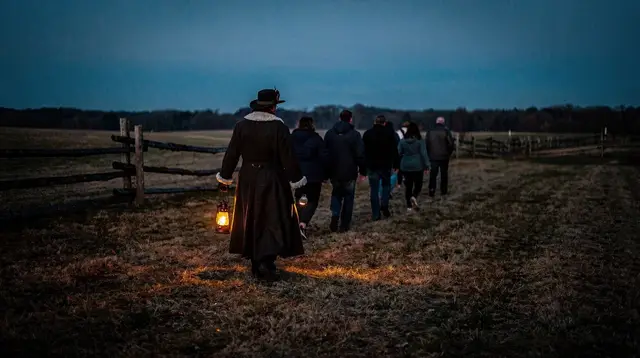
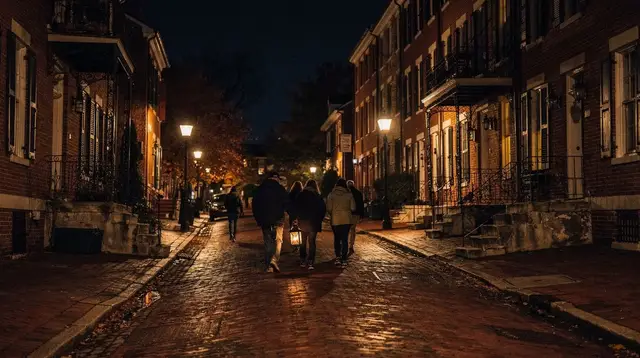
That paid-admission structure is exactly why ghost tours exist as a separate evening layer rather than being bundled into your day ticket. Colonial Williamsburg’s own daytime admission gets you into historic trade shops, house museums and costumed-interpreter programming during operating hours. Evening ghost tours, by contrast, are largely run by independent private tour companies that operate on the public streets of the historic area after the daytime sites close, using storytelling, lantern-lit walks and stops outside (and sometimes inside) landmark buildings to carry visitors through the town’s darker folklore.
Practically, this means you don’t need to buy anything extra to walk the streets at night — most ghost tour companies meet visitors on public sidewalks and squares — but you also won’t get let into a locked historic house museum without the day ticket. Read each tour’s description carefully: some are pure outdoor walking tours through the streets and gardens, others weave in stops at working taverns where you can also eat or drink as part of the experience.
What a Williamsburg ghost tour actually covers
Because the town’s history runs from the 1630s founding of the area through the Revolutionary era and well into the 19th and 20th centuries as a working town before restoration began in the 1920s, ghost guides here pull from an unusually long timeline. Expect stories about:
- Colonial-era deaths, disappearances and unexplained illness in family homes now preserved as museum houses
- Tavern keepers, servants and enslaved residents whose lives (and, in the folklore, afterlives) are tied to specific buildings still standing today
- Courthouse and public-square incidents from the town’s role as Virginia’s colonial capital
- Later-era hauntings from the town’s centuries as an ordinary Virginia community, before the Rockefeller-funded restoration turned it into a historic site
- General folklore, urban-legend material and modern paranormal-investigation claims layered onto genuinely old buildings
This is a fundamentally different mix from a battlefield tour, where the entire narrative compresses into a few days of fighting. A Williamsburg guide has three-plus centuries of material to draw from, and most operators build their route around a rotating set of buildings and squares rather than a single dramatic event.
Comparing the ghost tour formats
| Tour style | What it adds | Best for |
|---|---|---|
| Standard ghost walk | Guided storytelling loop past historic houses and streets | First-time visitors, general audience |
| “Original” ghost walk | Long-running, established route often cited as the classic version | Visitors wanting the best-known local option |
| Ghost tavern / pub crawl | Stops at colonial-era taverns along the story route | Adults wanting food or drinks worked into the evening |
| Dark history / murder tour | Focused on true-crime and darker historical incidents | Teens and adults comfortable with heavier subject matter |
| Pirate-themed tour | Leans into pirate-era Virginia coastal folklore | Families with kids drawn to a lighter, adventure framing |
an evening ghost stories walk through Colonial Williamsburg’s historic streets is the most straightforward starting point if you want one guided walk covering the town’s best-known hauntings without committing to a themed format. For visitors who want the tour most closely associated with the town’s ghost-tour tradition, the Original Ghost Walk of Colonial Williamsburg is generally the reference version other companies are compared against.
If part of your evening plan includes dinner or drinks anyway, a ghost-themed tavern pub crawl through Colonial Williamsburg folds storytelling and stops at historic taverns into one outing, which suits couples or groups of adults more than young families. For a lighter, adventure-flavored angle that still works well with children, a pirate-themed walking tour of Williamsburg shifts the focus toward coastal Virginia’s pirate-era folklore rather than hauntings specifically.
Visitors who want the heavier end of the spectrum — and who are comfortable with material aimed at teens and adults rather than younger kids — should look at a dark history and true-crime walking tour of Williamsburg, which digs into documented crimes and darker incidents from the town’s past rather than general ghost folklore.
Williamsburg’s ghost-tour market includes several competing operators covering overlapping ground, so it’s worth knowing you’re not limited to a single company’s version of events. a Ghostly Whispers guided walk through Colonial Williamsburg offers another lantern-lit route through the historic district, with its own selection of stops and stories — useful if you’re staying multiple nights and want to compare two different guides’ takes on the same streets, or if your first-choice tour is sold out for the evening you need.
Planning your evening: pairing the daytime ticket with a night tour
Because Colonial Williamsburg’s day ticket and its evening ghost tours are sold separately, the practical planning question isn’t “which one do I pick” but “how do I sequence both in the same visit.” Most travelers staying near the historic area spend the day inside the paid site — trade shops, historic houses, costumed interpreters — then use the evening for a ghost walk as a lower-cost, lower-commitment add-on that doesn’t require a second day or a separate trip.
If you haven’t yet decided on your daytime plan, Colonial Williamsburg’s general admission ticket is the base you’ll want before exploring the historic area by day, and pairing it with a private walking tour of Colonial Williamsburg’s colonial history during daylight hours gives you the historical grounding that makes the evening’s ghost stories land better — many guides reference buildings and family names you’ll recognize if you toured the district earlier that day.
Families visiting in December have an additional seasonal option worth knowing about: a Christmas-season walking tour of Colonial Williamsburg that includes a gift, which swaps the after-dark ghost framing for holiday history and traditions — useful if you’re traveling with younger children who’d rather skip the spooky content entirely.
Because this is a same-site evening activity rather than a day trip, it slots naturally into a broader Virginia itinerary. If Williamsburg is one stop among several, see historic Virginia for how it fits alongside Jamestown, Yorktown and Richmond, or Williamsburg, Jamestown and Yorktown compared if you’re still deciding how to split your time across the three sites.
For travelers debating whether the historic area is worth the admission at all, is Colonial Williamsburg worth it tackles that question directly, while Williamsburg walking tours covers the daytime, non-ghost-themed alternative for visitors who’d rather explore without the folklore angle.
Getting there and where Williamsburg fits regionally
Williamsburg sits within the Historic Virginia region, roughly two and a half to three hours’ drive from Washington, D.C. — a genuine day-trip stretch, though most visitors doing ghost tours stay overnight given the combination of a full day at the historic site plus an evening tour. If you’re coming from the capital, a Williamsburg day trip from Washington, D.C. lays out the driving logistics, and things to do in Williamsburg is the broader activity hub if ghost tours are just one piece of a longer stay.
Travelers extending the trip toward the coast can continue on to Norfolk or Virginia Beach, both within the Atlantic Coast region, while those working backward toward the capital often pair Williamsburg with a stop in Richmond — itself home to its own, very differently themed ghost tour rooted in Civil War and capital-city history rather than colonial life.
Ghost tours elsewhere in the capital region
If Williamsburg is just one stop on a longer trip through the region, ghost tours turn out to be a recurring evening activity at several of the historic sites within reach of Washington, D.C. — though each one draws on a completely different era of history. In Richmond, the former Confederate capital, a ghost walk through Richmond’s historic Court End district leans on Civil War-era and antebellum stories rather than Williamsburg’s colonial folklore — a useful contrast if you’re doing both cities on the same swing through Virginia.
Further north, in Gettysburg, the ghost-tour scene is built almost entirely around the three-day battle and its aftermath. a two-hour ghost hunt at the historic Farnsworth House in Gettysburg is one of the best-known options there, and it makes an instructive comparison with Williamsburg: the same broad genre of after-dark storytelling, but one built on a single catastrophic battle and the other on three centuries of ordinary town life.
Closer to the capital itself, Washington, D.C. has its own after-dark walking tours, though these lean toward general nighttime sightseeing and spy-and-crime history rather than ghost stories specifically — see an evening After Dark walking tour of Washington, D.C. if you want a nighttime outing in the capital before or after your Virginia leg of the trip. None of these substitute for a Williamsburg-specific tour, but they’re worth knowing about if ghost and after-dark tours have become a running theme of your itinerary.
Williamsburg ghost tours: frequently asked questions
Is Colonial Williamsburg free like the National Mall in Washington?
No. Unlike the free Smithsonian museums and monuments in Washington, D.C., Colonial Williamsburg is a large paid historic site with its own admission ticket. Ghost tours are a separate, additional evening activity on top of that entry fee.
Do Williamsburg ghost tours cover Civil War stories?
Generally not. Colonial Williamsburg’s identity and its ghost lore are rooted in 18th-century colonial life — taverns, courthouses, print shops and family homes — rather than Civil War battle history, which belongs to sites like Gettysburg or Richmond.
Are Jamestown and Yorktown included in a Williamsburg ghost tour?
No. Jamestown and Yorktown are separate historic sites with their own admission and their own operators. A Williamsburg ghost tour stays within Colonial Williamsburg’s restored district and does not include entry to either neighboring site.
Do I need to buy the daytime Colonial Williamsburg ticket to take a ghost tour?
It depends on the operator, but most evening ghost walks take place on public streets within the historic area and do not require the daytime ticket. Some tours do stop at or reference buildings that are only open with paid admission during the day, so many visitors combine both.
Are Williamsburg ghost tours suitable for kids?
Many are family-friendly and lean toward storytelling and folklore rather than graphic content, but some tours (murder or dark-history themed walks) are pitched at adults and teens. Check the specific tour’s description before booking for younger children.
How long does a typical ghost tour in Williamsburg last?
Most evening walking tours run around an hour to ninety minutes, covering a loop of the historic area’s streets, taverns and notable houses on foot at an easy pace.
What’s the difference between a ghost walk and a ghost tavern pub crawl in Williamsburg?
A ghost walk is a guided walking tour focused on stories and stops at historic buildings, while a tavern-style tour adds a pub-crawl format, stopping at colonial-era taverns along the way as part of the evening.
Is one company the only option for a Williamsburg ghost tour?
No. Several independent operators run overlapping routes through the same historic streets, from the long-running Original Ghost Walk to other guided walks covering similar ground, so if one evening’s tour is sold out it’s often worth checking whether a competing company is running a walk the same night.
DC Ghost Tours
Verified deep-linked GetYourGuide tours. Book through these links and we earn a small commission at no cost to you.
GetYourGuide does not provide a product photo for this activity — the image shows the meeting point, photographed by us.