Gettysburg Ghost Tours: The Complete Guide
Are Gettysburg ghost tours part of the official battlefield park?
No. Gettysburg National Military Park and its Foundation-run museum, film and licensed battlefield guides are separate, official activities. Ghost tours are privately run, evening walking or hunt-style experiences through the town of Gettysburg, sold by independent local operators and unaffiliated with the National Park Service.
Two Different Gettysburgs After Dark
Spend a day at Gettysburg and you’ll notice the town runs on two separate tracks. By day, it’s Gettysburg National Military Park: free roads and monuments you can drive or walk on your own schedule, plus a paid museum, a paid film, and paid tours from Licensed Battlefield Guides certified through the National Park Service. By evening, a second, entirely private economy takes over — dozens of ghost tours operating out of storefronts along the historic downtown, selling lantern-lit walks and ghost hunts through buildings that served as field hospitals in July 1863.
These two Gettysburgs are not the same thing, and they don’t answer to the same authority. The battlefield park and the Gettysburg Foundation have no role in the ghost-tour business; the ghost tours, in turn, have no claim on the battlefield’s official narrative. If you’ve spent your afternoon with a Licensed Battlefield Guide walking the ridge lines and troop positions, the evening ghost tour you book afterward is a completely different product, run by a completely different operator, with a completely different aim: not to explain the battle’s tactics, but to sit with what it left behind in the town itself.
This guide covers how that ghost-tour side of Gettysburg actually works: who runs it, what a typical evening looks like, how it fits with the rest of your visit to Civil War Country: Gettysburg, Antietam, Harpers Ferry and Fredericksburg, and how to pick between the walking tours, the ghost hunts, and the handful of other after-dark options clustered around the same few blocks.
Why Gettysburg, Specifically
Every Civil War town has its stories, but Gettysburg carries a specific weight that shapes what its ghost tours are actually about. Over three days in July 1863, the battle produced roughly 51,000 casualties — killed, wounded, captured or missing — making it the single bloodiest battle of the Civil War and the bloodiest ever fought on American soil. A town of a few thousand residents was overwhelmed almost overnight: churches, homes, barns, and the seminary and college buildings on the edge of town were converted into makeshift field hospitals, and the wounded and dying filled every available space for weeks after the fighting stopped.
That’s the material Gettysburg’s ghost tours draw on, and it’s worth naming plainly because it distinguishes this town from the other two ghost-tour destinations covered elsewhere in this guide series. Williamsburg’s ghost tours lean on colonial-era hauntings tied to 18th-century domestic life and the town’s role as a colonial capital.
Richmond’s ghost tours work the political and institutional weight of a Confederate capital under siege. Gettysburg’s folklore is different in kind: it’s rooted in mass casualty and improvised medicine, in buildings that briefly functioned as hospitals for thousands of wounded men, not in domestic architecture or wartime politics. Guides here talk less about grand houses and more about surgery tables, overflowing basements, and the specific rooms where soldiers died.
Where Gettysburg Actually Is
One correction worth making before booking anything: Gettysburg is in Pennsylvania, not Virginia. It sits north of the Mason-Dixon Line, and while it’s grouped with Virginia’s Civil War sites in most trip planning because of shared subject matter, its geography puts it in a different state entirely.
If you’re building a Civil War-themed itinerary from Washington, Fredericksburg and Harpers Ferry are the Virginia (and West Virginia) stops; Gettysburg and Antietam sit further north, in Pennsylvania and Maryland respectively. It’s an easy mix-up given how often these towns appear together on the same trail, but the state line matters if you’re checking drive times or state-specific travel rules.
Getting There From Washington
There’s no single fixed drive time from D.C. to Gettysburg, but plan on roughly an hour to an hour and a half by car, depending on traffic and your starting point in the metro area. That puts it within range of a long day trip: arrive by mid-morning, spend the afternoon on the battlefield with a Licensed Battlefield Guide or on a self-guided driving tour, have dinner in town, and finish with an evening ghost tour before heading back — or better, stay overnight and drive back the next morning rather than pushing a battlefield day and a late-night return into the same stretch of driving.
For the daytime half of that plan, see Gettysburg battlefield tours and the broader Gettysburg day trip from Washington, D.C. planning guide.
What a Gettysburg Ghost Tour Actually Involves
Ghost tours in Gettysburg fall into a few recognizable formats, and it’s worth knowing the difference before you book.
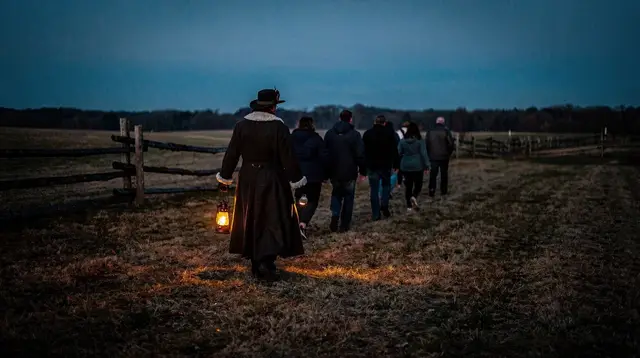
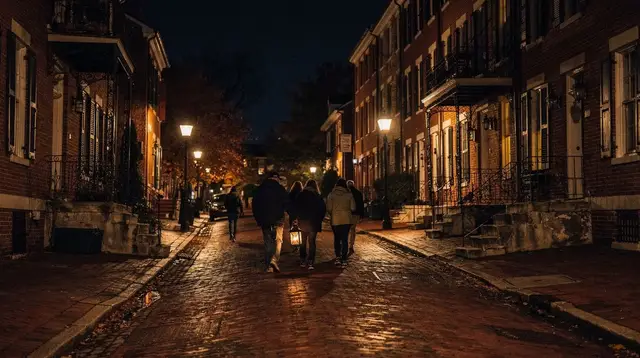
Walking tours are the most common format: a guide leads a small group on foot through a few blocks of the historic downtown, stopping at specific buildings — former hospitals, homes with documented deaths, sites tied to specific soldiers’ stories — and narrating the history alongside the reported hauntings. A guided evening walk through the college grounds, which served as a field hospital during and after the battle is a good example of this format, and a walk down one of the town’s main historic corridors covers a different stretch of ground with its own set of stories.
Ghost hunts go a step further, typically confined to a single building rather than moving through the streets, and often include hands-on use of equipment such as EMF meters or dowsing rods. A ghost-hunt session inside a historic house used as a field hospital runs longer than a standard walking tour and leans more into investigation than narration, and a outdoor ghost hunt at bridges associated with the battle, with equipment provided takes the same approach outside the town center.
All-ages and family-oriented tours exist too, generally pitched as historical storytelling with a lighter touch on the paranormal claims. An all-ages ghost tour built around storytelling rather than equipment-based investigation and a family-friendly tour pairing local history with lighter ghost stories are both worth checking if you’re planning to bring children, since not every tour in town is written for them. On the more intense end, a beginner-oriented paranormal investigation tour and a tour framed specifically around the stories of soldiers who died in the town’s makeshift hospitals lean further into the darker, more immersive end of the format,, both aimed at visitors who want the darker, more immersive end of the format rather than a lighter storytelling walk.
None of these formats overlap with what the battlefield park itself sells. There’s no ghost content in the museum, the film, or a Licensed Battlefield Guide’s tour — that material stays factual and daytime. The ghost tours are a separate, privately run evening layer on top of the same history.
The Farnsworth House: Gettysburg’s Most Famous Haunted Address
If one address anchors Gettysburg’s ghost-tour reputation, it’s the Farnsworth House. The building took heavy damage during the battle — bullet holes are still visible in its exterior brick — and it served, like so many structures in town, as a makeshift hospital in the days after the fighting. That history has made it the single most-booked location among Gettysburg’s ghost-tour operators, with several distinct experiences run out of the same property rather than one generic tour.
A tour through the building’s haunted cellar focuses on the below-ground spaces where the reported activity concentrates, while a tour centered on the “phantom regiments” folklore tied to the property takes a more narrative approach to the same building’s history. For visitors who want a longer, more hands-on session, a four-hour ghost hunt with investigation equipment and a shorter two-hour version of the same format give a choice between a full evening commitment and a more contained one. Because all of these run out of the same address, it’s worth picking based on format and length rather than assuming one is more “authentic” than another — the difference is mostly in structure, not in the underlying material.
Ghost Tours vs. the Official Battlefield: A Quick Comparison
| Battlefield park & Foundation | Ghost tours | |
|---|---|---|
| Run by | National Park Service / Gettysburg Foundation | Independent local operators |
| Timing | Daytime | Evening |
| Cost of the core experience | Free to drive/walk the battlefield; museum, film and guides are paid add-ons | Always a paid, ticketed activity |
| Focus | Military history, tactics, troop movements | Folklore, paranormal claims, human toll |
| Guide credential | Licensed Battlefield Guide (NPS-certified) | No NPS certification; private guiding |
| Typical length | Battlefield driving tour: a few hours; guided tour: 1.5-2 hours | 60-90 minutes for walks; longer for ghost hunts |
Fitting a Ghost Tour Into a Civil War Day Trip
For most visitors, the ghost tour is the last stop on a day that started at the battlefield.
A workable sequence: arrive by mid-morning and spend a couple of hours on the driving tour or with a Licensed Battlefield Guide, visit the museum and film if the military history is the priority, have an early dinner in the historic downtown, and book a ghost tour for early evening rather than the last slot of the night — most run into full darkness anyway, and an earlier start leaves margin for the drive back to Washington or for driving on to Antietam or Harpers Ferry the following day as part of a longer Civil War Country: Gettysburg, Antietam, Harpers Ferry and Fredericksburg loop.
If you’re weighing Gettysburg against Antietam for a single-battlefield day, note that Antietam doesn’t have the same concentrated ghost-tour industry — it’s a much smaller town with far less built-up tourist infrastructure, so the after-dark option described here is really a Gettysburg-specific addition to your itinerary, not something you’ll find replicated at every Civil War stop nearby.
For travelers building out a full Civil War battlefields guide itinerary across several sites, Gettysburg is the one stop where the evening genuinely offers something distinct from the daytime program, rather than more of the same material after dark.
Choosing Among Gettysburg’s Ghost Tour Formats
With this many operators clustered into a few historic blocks, the choice usually comes down to three questions rather than picking a name at random.
How much time do you have left in the evening? If you’re combining a full battlefield day with the ghost tour, a standard walking tour in the 60-to-90-minute range fits more comfortably after a late dinner than a multi-hour ghost hunt. If the ghost tour is the main event of the evening — say you arrived in town specifically for it, or you’re staying overnight — one of the longer investigation formats, including the Farnsworth House’s four-hour option, makes better use of the time.
Do you want narration or investigation? Walking tours and the family-oriented formats are built around a guide telling stories as you move between locations. Ghost hunts flip that balance: less narration, more time standing still in one room with equipment, waiting to see what, if anything, registers. Neither is objectively better — it’s a question of whether you want to be told a history or take part in trying to document something yourself.
Who’s coming with you? A mixed group with children fits more naturally with the all-ages or family-friendly options than with an equipment-heavy investigation pitched at adults. If the group is older teens or adults specifically looking for the more intense end of the format, the Farnsworth House tours and the beginner paranormal investigation option are built for that audience instead.
For a broader look at what else fills a Gettysburg evening beyond the ghost-tour scene, see things to do in Gettysburg, and for how this after-dark option compares with evening options elsewhere in the region, see day tours vs. night tours in Washington, D.C..
Booking Notes
A few practical points apply across most Gettysburg ghost tours: groups are usually small and capped, tours run rain or clear regardless of weather in most cases, and advance booking is worth doing in peak season (summer weekends and the days around the battle’s anniversary in early July) since popular evening slots sell out. Comfortable walking shoes matter more than costume or props — most of an evening is spent standing and walking slowly between stops, not sitting. If you’re deciding between two similarly timed options, check whether the price covers equipment rental for a ghost hunt or is purely a guided walk, since that difference explains most of the cost gap between formats.
Frequently Asked Questions About Gettysburg Ghost Tours
Are Gettysburg ghost tours run by the National Park Service?
No. The battlefield itself, its museum, film and Licensed Battlefield Guides are run through Gettysburg National Military Park and the Gettysburg Foundation. Ghost tours are private evening businesses operating in the town, entirely separate from that official structure.
Do I need to pay to see the Gettysburg battlefield itself?
No. You can drive or walk the battlefield’s roads and monuments for free at any time. Only the museum, the film, and hiring a Licensed Battlefield Guide carry a fee, and none of those are ghost tours.
Is Gettysburg in Virginia?
No. Gettysburg is in Pennsylvania, north of the Mason-Dixon Line. It’s easy to lump it in with Virginia’s Civil War sites, but Fredericksburg and Harpers Ferry are the Virginia-area stops on that trail, not Gettysburg.
How long does a Gettysburg ghost tour last?
Most walking-style ghost tours run about 60 to 90 minutes, covering a few blocks of the historic downtown. Ghost-hunt formats at a single haunted building, such as a former field hospital, can run longer with equipment demonstrations included.
Are Gettysburg ghost tours suitable for kids?
It varies by operator. Some tours are marketed as family-friendly historical storytelling, while others lean into ghost-hunting equipment and darker material aimed at adults and older teens. Check the specific tour’s age guidance before booking for children.
How far is Gettysburg from Washington, D.C.?
It’s a drive of roughly an hour to an hour and a half from Washington, D.C., depending on traffic and starting point, making it a realistic day trip that can end with an evening ghost tour before heading back.
What’s the difference between a ghost tour and a Licensed Battlefield Guide tour?
A Licensed Battlefield Guide, certified through the National Park Service, leads factual, daytime tours of the battlefield’s military history. Ghost tours run in the evening, focus on folklore and paranormal claims tied to the battle’s aftermath, and are led by private local guides with no NPS certification requirement.
DC Ghost Tours
Verified deep-linked GetYourGuide tours. Book through these links and we earn a small commission at no cost to you.
GetYourGuide does not provide a product photo for this activity — the image shows the meeting point, photographed by us.