Baltimore Ghost Tours: Haunted History of a Working Port City
Are Baltimore ghost tours worth it if I'm coming from Washington, D.C.?
Yes for an evening add-on: Baltimore is 35-60 minutes from DC, so a ghost tour pairs easily with a daytime Inner Harbor visit as a half-day or evening excursion rather than a separate trip. The tours run as guided walks or pub crawls through the historic port district after dark.
A port city’s ghost stories, not a colonial capital’s
Baltimore and Annapolis sit close together on the Chesapeake, share a state, and both offer ghost tours after dark — which makes it easy to assume they’re interchangeable. They aren’t. Annapolis is Maryland’s small colonial-era capital, a compact grid of statehouse streets and a sailing harbor where the hauntings trace back to government buildings, taverns tied to early American politics, and a walkable historic core. Baltimore is something else entirely: a large industrial and maritime port, built around shipping, manufacturing, and immigration, with a footprint and a history several sizes larger than its neighbor to the south.
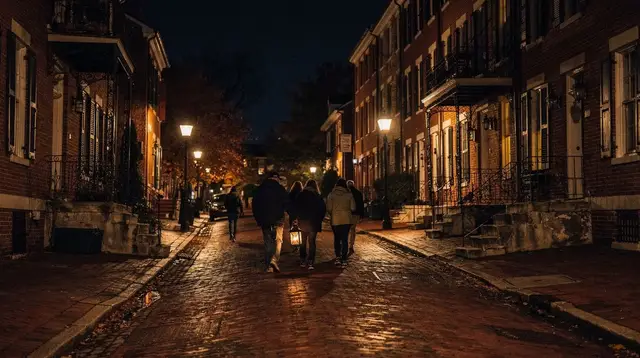
That difference matters for what a Baltimore ghost tour actually is. This isn’t a stroll past a handful of colonial landmarks — it’s a night walk (or pub crawl) through dense, working port neighborhoods like Fells Point, where sailors, dockworkers, and generations of immigrant communities lived, worked, and, according to local lore, sometimes stayed on after dark. If you’ve already done a ghost tour in Annapolis or are planning one, Baltimore is worth treating as a distinct experience rather than a repeat of the same evening.
Why Baltimore, and why after dark
Baltimore’s daytime identity is built around the Inner Harbor — a working waterfront turned tourist promenade lined with individually ticketed attractions: the National Aquarium, historic naval ships, science and industry museums. The harbor walk itself is free, but nearly everything you’d stop at along the way charges its own separate admission. That’s a very different rhythm from Annapolis, where the harbor is smaller and the paid stops are fewer and more concentrated around the historic district.
A ghost tour fits naturally into the other half of the day: the evening, once the ticketed attractions have closed and the harbor district takes on a different character. Rather than trying to squeeze a night tour into an already full afternoon of paid sightseeing, most visitors treat it as the capstone of the day — dinner near the harbor, then a guided walk or pub crawl through the older streets once it’s dark.
How a Baltimore day trip and evening tour fit together
Baltimore sits roughly 35 to 60 minutes from Washington, D.C., by car or train — close enough that it works as a half-day or full-day trip rather than something requiring an overnight stay. That timing is exactly what makes an evening ghost tour a realistic add-on rather than a separate journey:
| Time of day | Typical activity |
|---|---|
| Morning | Travel from DC (35-60 minutes), arrive at the Inner Harbor |
| Midday–afternoon | Ticketed Inner Harbor attractions, waterfront walking, historic ships and museums |
| Early evening | Dinner in a harbor-adjacent neighborhood like Fells Point |
| After dark | Guided ghost tour or haunted pub crawl |
| Night | Return trip to Washington |
This structure means you don’t need to choose between the daytime port-city sightseeing and the after-dark storytelling — they stack into one outing. It also means a Baltimore ghost tour is realistic as an evening activity even for visitors based in Washington who aren’t staying overnight in Maryland.
What sets the storytelling apart
Because Baltimore grew as a shipping and industrial port rather than a seat of colonial government, its ghost-tour material tends to draw on a different well of history than Annapolis: dockworkers, sailors, saloons that served a working waterfront, dense immigrant row-house neighborhoods, and the kind of maritime trade that built the city’s wealth and its hazards alike. Guides working the harbor district frame their stories around that industrial-port identity rather than around statehouses or naval academies, which is the same distinction that separates Baltimore’s things to do more broadly from Annapolis’s.
Several tour formats exist around this theme:
a walking tour through Fells Point aimed squarely at an adult audience, threading the neighborhood’s waterfront taverns and row houses after dark, a themed evening walk built around the city’s darker folklore and history, and a haunted pub crawl that combines the storytelling format with stops at historic drinking establishments — a good fit if you’d rather make the evening a social outing than a straight walking tour.
No single stop, exact schedule, or price is fixed across these tours; formats and routes are set by the operators and change over time. What’s consistent is the setting: old port streets, after-dark timing, and a narrative rooted in Baltimore’s identity as a working harbor city rather than a colonial capital.
Pairing the evening with the rest of the harbor
If a ghost tour is the evening plan, the rest of the day is a good time to cover the Inner Harbor’s paid attractions and the general character of the waterfront. A sunset cruise around the harbor makes a scenic transition between the daytime sightseeing and the after-dark walk, giving you a view of the working port from the water before you explore its streets on foot after nightfall. For a lower-key evening that still keeps you near the harbor, a casual dinner stop is an easy way to fill the gap between daytime attractions and a night tour’s start time.
None of this requires an overnight stay. Because the trip back to Washington takes under an hour by car or train, an evening ghost tour can genuinely be the last thing you do before heading home — no need to book a hotel just to fit in the after-dark activity.
Setting expectations
A few things worth keeping straight before booking:
- This is a port-city theme, not a colonial one. If you’re comparing tours across Maryland, expect Baltimore’s stories to center on shipping, industry, and dense waterfront neighborhoods — not statehouses or academies. That’s the through-line that separates it from Annapolis.
- Inner Harbor attractions are separate purchases. The aquarium, historic ships, and museums each carry their own admission; a ghost tour doesn’t include or substitute for any of them.
- It’s an evening activity by design. Ghost tours run after dark, which makes them a natural way to close out a day trip rather than something to squeeze in alongside daytime sightseeing.
- Some tours are adults-only or pub-crawl format. Check the style of a given tour — walking tour versus pub crawl, general audience versus adults-only — before booking, especially if traveling with children.
- Baltimore is a short trip from DC, not a long one. At 35 to 60 minutes each way, there’s no need to overbuild the logistics around an evening tour; it fits inside a single day trip.
How Baltimore compares to other haunted-history stops in the region
Baltimore isn’t the only place within reach of Washington that runs after-dark storytelling walks, and travelers building out a longer trip often end up comparing several of them. Annapolis ghost tours lean on statehouse and colonial-era lore, as already covered above. Further south, Alexandria ghost tours work a similar colonial-port angle just across the Potomac from Washington, while Washington DC’s own ghost tours draw on a mix of political intrigue and monument-adjacent lore rather than maritime trade. Head further afield and the theme shifts again: Gettysburg ghost tours and Williamsburg ghost tours are built around battlefield and colonial-settlement history respectively, and Richmond ghost tours draw on the city’s own Civil War and antebellum past.
None of these substitute for Baltimore’s port-city framing — that’s the point. If you’re deciding between a Baltimore evening and one somewhere else in the region, the honest answer is that they tell genuinely different stories rather than variations on the same script. A traveler working through several of these destinations over a longer trip might, for instance, pair a Baltimore evening with a separate guided haunted-history walk through Richmond or a tour focused on Richmond’s own bloody past on a different leg of the same regional itinerary, rather than treating any one city’s tour as a full substitute for another’s.
If Washington itself is where the trip is centered, it’s also worth knowing that the capital runs its own after-dark options on nights when a Baltimore day trip isn’t on the schedule — a lantern-lit ghost walk through DC or a private evening tour with hotel pickup covers similar after-dark ground without leaving the district.
Building Baltimore into a longer Washington trip
A single evening ghost tour is easy to bolt onto an existing DC-based trip, but it’s also worth thinking about how it fits if Baltimore becomes more than a half-day errand. Travelers who want to give the Inner Harbor more than an afternoon sometimes extend it into a full two-day visit — see Baltimore and the Inner Harbor in two days for a structure that gives the harbor’s museums, historic ships, and neighborhoods room to breathe before the ghost tour closes out an evening. For a shorter visit, the Baltimore day trip from Washington guide and the broader things to do in Baltimore roundup both cover how to structure the daylight hours around an evening tour.
Baltimore’s after-dark identity isn’t limited to ghost stories, either. The city also has a serious wine and brewery scene and a growing slate of cooking classes, both of which slot into the same early-evening window that a ghost tour would otherwise fill — useful if you’re visiting more than once and want a different kind of night out on a return trip. A hands-on cooking class with a local chef or a dumpling-making class makes for a lighter, food-focused alternative to the pub crawl format on a second Baltimore evening.
For travelers coming from further than downtown DC, the region around Baltimore connects easily into a broader Chesapeake Bay trip. If sailing, seafood, or the bay itself is part of the plan, Chesapeake Bay seafood and sailing and the Chesapeake and Annapolis two-day itinerary both treat Baltimore as one stop among several rather than the whole trip — a useful frame if a ghost tour is just the evening capstone on a bay-wide loop that also touches Annapolis.
If you’re basing the trip in Washington instead
Not every visitor treats Baltimore as the day’s main destination. Some are staying in Washington and only adding Baltimore as one evening among several DC-based nights out. If that’s closer to your situation, it’s worth knowing what else fills the same after-dark slot back in the capital: a evening neighborhood food tour or a Georgetown history and architecture walk covers similar guided-evening-walk territory without the trip out to Maryland. For a daytime alternative closer to home, a half-day trip to Mount Vernon pairs well with an evening back in the district.
However you structure the days around it, getting to Baltimore itself is straightforward: it sits on the same Northeast rail corridor as Washington, and the train and bus day trips from Washington guide covers the practicalities of doing it without a car, while the broader Washington DC day trips guide places Baltimore alongside the other half-day and full-day options within reach of the capital.
Getting the most from a Baltimore ghost-tour evening
How does a Baltimore ghost tour differ from one in Annapolis?
Baltimore’s tours are built around its identity as a large industrial and maritime port — shipping, dockworkers, immigrant neighborhoods, and waterfront taverns. Annapolis, as Maryland’s compact colonial capital and sailing harbor, draws its ghost-tour material from statehouse and colonial-era history instead. The two cities share a region but tell very different stories after dark.
Do I need to plan a full day around a ghost tour, or can it just be an evening add-on?
It works well as an evening add-on. Since Baltimore is only 35 to 60 minutes from Washington, many visitors spend the day at the Inner Harbor’s ticketed attractions and treat the ghost tour as the closing activity before the trip back.
Are the Inner Harbor attractions included in a ghost-tour ticket?
No. The Inner Harbor’s attractions — the aquarium, historic ships, museums — are each individually ticketed and entirely separate from any evening ghost tour. Budget for them as separate stops in your day.
What should I expect stylistically from a Baltimore ghost tour?
Expect a walking format (or, for pub-crawl versions, a mix of walking and bar stops) through older waterfront neighborhoods like Fells Point, with storytelling framed around the city’s port and industrial past rather than a specific named haunted site or fixed itinerary.
Is it possible to do this as a day trip without staying overnight in Baltimore?
Yes. With the trip from Washington taking under an hour each way, an evening ghost tour can be the last activity of a single-day trip, with plenty of time to return to DC afterward.
Should I book the daytime Inner Harbor attractions and the evening ghost tour together, or separately?
They’re generally separate bookings, since they’re run by different operators and serve different parts of the day. Treat them as two parts of the same day trip rather than a single combined package.
Are these tours geared toward couples, groups, or solo travelers?
Formats vary — some are general walking tours, others are explicitly adults-only or built around a pub-crawl social format — so the right fit depends on the group. Check each tour’s description for its intended audience before booking.
DC Ghost Tours
Verified deep-linked GetYourGuide tours. Book through these links and we earn a small commission at no cost to you.
GetYourGuide does not provide a product photo for this activity — the image shows the meeting point, photographed by us.